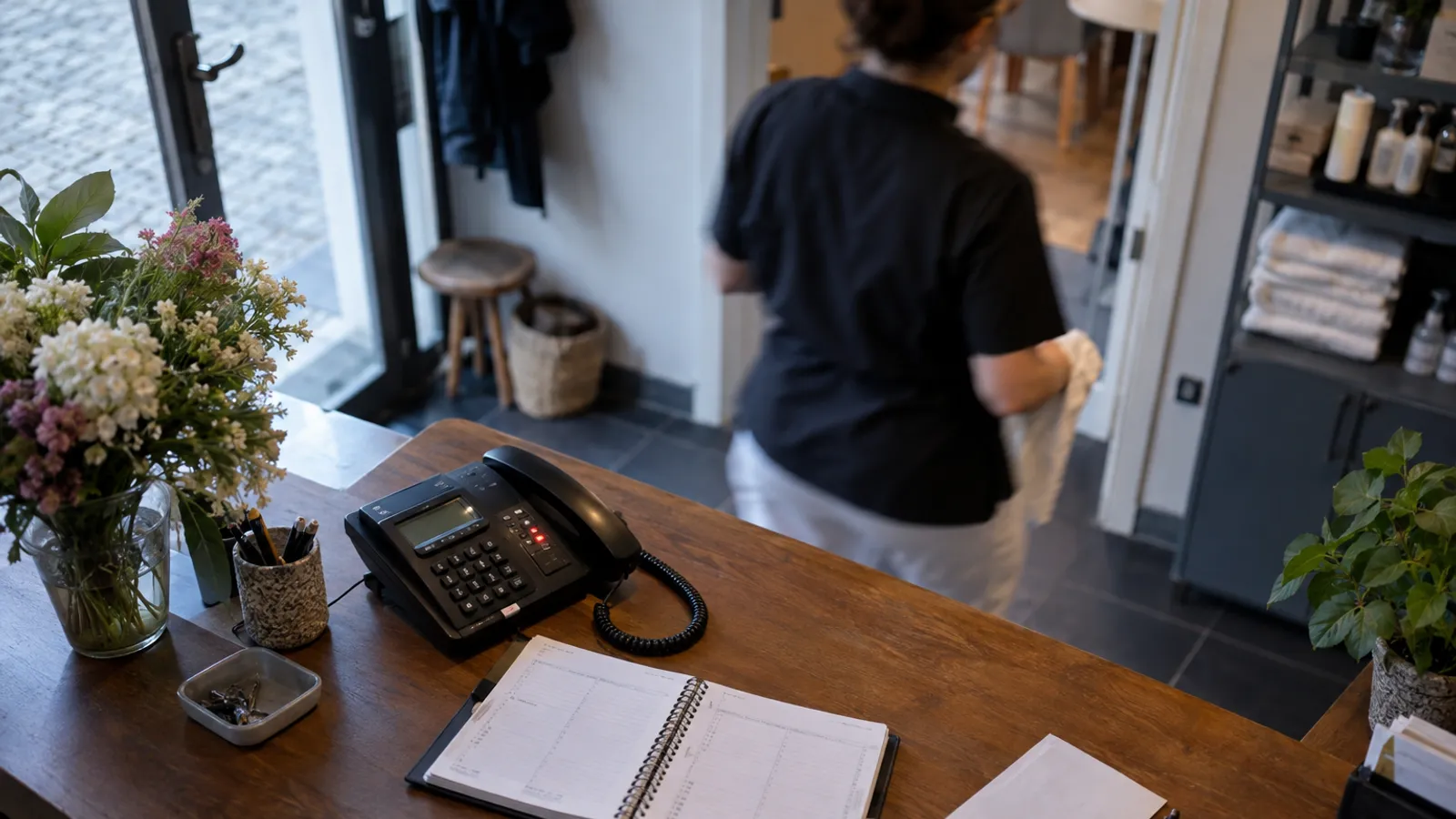
Your phone rings out, and your competitor picks up

The phone rings while you’re helping a customer. A machine is running in the workshop, someone is waiting at reception, and lunch is the only quiet half-hour of the day. Later, you spot the missed call and ring back. Perhaps you reach them. Perhaps they’ve already called someone else. That’s where the overlooked value of an AI phone assistant lies. It isn’t there simply to replace people. It can stop a customer’s request from disappearing between the ringing and the call back. But which conversations can it really handle without putting your customers’ trust at risk?
Calls fall into the gaps
In a small business, answering the phone is rarely someone’s only job. The owner of a trade business picks up between site visits. At a medical practice, the phone rings while a patient is asking a question at reception. At a hotel, someone calls about arrival just as reception is checking in the next guest. It doesn’t take a rush of calls for one to go unanswered.
The work shows up later: find the number, call back, piece together what the person needed, perhaps ask them to explain it again. On its own, that may seem minor. But when call backs land among quotes, customer appointments and emails, they become another interruption that follows you through the day. And the caller is left wondering whether their request reached you at all.
A missed call doesn’t automatically mean a lost job. You can’t tell from the number in your call log what the person wanted. But it does show that someone with a specific need tried to reach your business and got no answer. What if you already had the details before your team called back?
The real cost isn’t on your phone bill
When people consider the cost of missed calls, they often think first of lost sales. That’s hard to measure if you don’t know what the caller wanted. The effects you can see in the day-to-day running of a business are more tangible: interrupted work, another attempt to call back, an enquiry without context or an appointment request that only makes it into the diary later.
Take a service business. Someone calls to report damage. If no one answers, they have to explain it all again later. If an assistant takes the call, captures their contact details and passes on the report in an orderly way, the team can make the call back with more context. That won’t turn every call into a job. It can, however, reduce the chance of important details going missing between the first call and the call back.
McKinsey reports that 42 per cent of surveyed leading customer care companies had reversed rising inbound contact volumes through self-service and digital routing. This is a survey finding about customer care, not a promise for any one business. Still, it points to a practical question: which recurring queries really need an immediate answer from a member of your team?
Routine calls can be handled. Difficult ones need a person
An AI phone assistant can answer incoming calls, handle common questions and record requests, contact details, appointment preferences and call-back requests. A trade business might use it for questions about opening hours and services. A medical practice could take appointment requests. A hotel could note questions about availability or arrival. The right task depends on how clearly your business can answer it.
The limits matter just as much as the task. An urgent report of damage, a complaint or a question outside the assistant’s approved knowledge shouldn’t get stuck in an automated loop. Set out when it should pass the call straight to your team, when it should take a call-back request and which cases only a person can handle.
The handover also has to work in the day-to-day running of the business. A message with the reason for the call, contact details and a preferred call-back time is more useful than a missed call, but only if it reaches the right person. Connecting your phone system to your calendar, CRM or email can send information to the right place. That raises another question: who checks that the entry is complete and dealt with promptly?
Sometimes customers want a person
For many people, a phone call is the quickest way to get an answer. That’s especially true when they’re unsure, need to explain a problem or have already been passed from one person to another. An assistant that sounds friendly but doesn’t understand the question or offer a handover can turn one bottleneck into another.
The McKinsey survey highlights this tension: 79 per cent of lagging companies and 64 per cent of leading companies cited customers’ preference for a live representative as a major barrier to moving to digital channels. Nearly 70 per cent of respondents also agreed that empathy and trust will always require human involvement. These figures relate to the companies surveyed, not every caller to your business.
When you introduce an assistant, tell callers at the start that they’re speaking to AI and briefly explain what it can do. They should have a way to reach a person. Your team needs clarity too. Staff should know which conversations are automated, who handles call backs and how to report errors or gaps in the assistant’s knowledge. Without those arrangements, the new task simply lands somewhere else.
What this means for your business
The best place to start is not with the technology. Start with your call log. Look at when calls go unanswered and which requests come up repeatedly. Ask the people who answer the phone every day: which questions keep coming up? Which conversations often end with missing information? And when does someone need to take over straight away?
Then choose one clearly defined use case. For example, answering questions about opening hours and taking call-back requests while the team is speaking to customers. Write down what information the assistant can use and what details it should collect. Set out which requests it must decline or pass to a person.
Test typical conversations, along with unclear answers, urgent cases and questions outside the intended scope. Once it’s in use, check regularly whether call-back requests are getting through, whether the details are enough to deal with them and where callers still need a person. Adjust the rules and information as the conversations show you what needs to change.
By next Monday, that could mean the first calls of the morning are answered while your team opens the workshop. A caller gets an immediate answer to a routine question. A new enquiry reaches the right colleague with the caller’s contact details and request. For a complex case, the phone still rings through to a person. Which one type of call would you take out of that gap first?
- Count missed calls and call-back attempts over a representative period.
- Group the most common requests by routine, need for clarification and urgency.
- Assign responsibility for escalations and call backs.
- After launch, review call outcomes, data protection and any changes needed.
A good start needs rules, not a perfect voice
Many businesses wait until they’ve mapped every process and anticipated every possible question. That can push a pilot further and further down the road. A better approach is to start small, with a clearly defined task, and let the team see what actually happens on the phone. Callers must be told they’re speaking to AI and know how to reach a person.
Data protection belongs in the plan, not in the footnotes. Before you start, decide what data will be collected, whether calls will be recorded or transcribed, and how long information will be kept. The answers depend on the specific use. Clear conversations and processes also make it easier to respond to questions from customers and staff.
For larger businesses, the same approach might cover several sites and more stringent approvals. A sole trader might start by taking call-back requests outside working hours. In either case, a person should review the rules and results regularly. Klarframe offers an AI phone assistant that records requests and contact details and can pass complex conversations to staff. The key is whether that handover fits the way your business actually works.
Frequently asked questions
What does an AI phone assistant do?
An AI phone assistant answers incoming calls and can handle common questions. Depending on the process you set up, it can record requests, contact details, appointment preferences or call-back requests, and pass complex conversations to staff. Decide in advance what it can handle, then review its performance as you use it.
Can an AI phone assistant stop you missing calls completely?
It can answer calls when staff are busy or unavailable. That doesn’t mean every call will be fully dealt with automatically. Complex or urgent requests need a clear handover to a person. As well as counting answered calls, check whether requests are recorded correctly and whether call backs actually happen.
Which businesses can benefit from an AI phone assistant?
It may suit businesses that receive recurring questions, appointment requests or call-back requests when staff can’t always answer the phone. That could include a trade business, medical practice, hotel or customer service team. Whether it’s worthwhile depends on how often these situations arise and whether handover arrangements are clear.
Does an AI phone assistant have to say it is AI?
According to its product information, Klarframe’s AI phone assistant identifies itself as AI at the start of a conversation. Businesses introducing an assistant should also provide a way to reach a person and decide what conversation data will be collected. Data protection arrangements, including recording and storage periods, need to fit the specific use.
How do you introduce an AI phone assistant in a business?
Start with one recurring, clearly defined task, such as answering common questions or taking call-back requests. Decide what information the assistant can use, what details it should collect and when it must pass a call to staff. Test unusual and urgent cases too. After launch, check that handovers arrive and include enough detail.
Interested?
Want to know what this means for your company?
Sources
- Klarframe: KI-Telefonassistent für eingehende Anrufe · klarframe.com
- Building trust: How customer care leaders pull ahead with AI · McKinsey & Company, 2026-02-23
- OpenAI unveils Presence, a new platform that lets enterprises launch and manage realtime voice agents and chatbots · VentureBeat, 2026-07-22
- Omilia raises $67M to scale its customer support platform · TechCrunch, 2026-08-06
This article was researched and written with AI assistance and automatically checked against the sources listed before publication. More on our AI transparency
Related solutions
- Inbound Voice Agent →
An inbound voice agent answers naturally, captures information and routes each request reliably.
Klarframe AI Readiness Check
How ready is your company for AI?
About ten minutes, instant result with your stage, a 90-day plan, suitable solutions and notes on the EU AI Act.